
Yellowstone is one of the last places on Earth where an entire large mammal food web still runs the way it evolved to. Six ungulate species and seven large predators share roughly 2.2 million acres, and the relationships between them read less like a nature documentary and more like a functioning machine. These Yellowstone wildlife facts cover the five species most visitors come to see: wolves, grizzly bears, bison, elk, and moose, plus the single month field biologists agree gives you the best chance of watching all five at once.
Wolf Facts: Yellowstone’s Keystone Predator
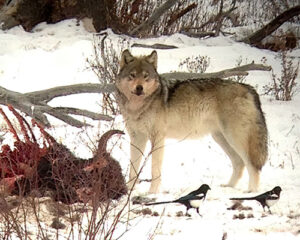
Gray wolves were reintroduced to Yellowstone in 1995 after being eliminated from the park by the 1920s. According to the National Park Service, at least 108 wolves were living primarily within Yellowstone as of January 2025, spread across multiple packs in the northern range and interior valleys. A pack functions as a family unit, with a breeding pair at its center and younger wolves helping raise that year’s pups. Wolves earned the label keystone predator because their presence changes the behavior of everything below them on the food chain, starting with where elk are willing to stand still long enough to graze.
Wolves and the River: The Trophic Cascade
When wolves disappeared, elk grazed river corridors without pressure to keep moving, and the willow and cottonwood that held those banks together thinned out over decades. Their return changed elk behavior more than elk numbers, and the vegetation, streambank, and beaver activity that followed is still being studied today. For the full mechanism, read our post on the trophic cascade in Yellowstone, which traces the chain from wolf howl to river channel.
Bison Facts: Ecosystem Engineers of the Prairie
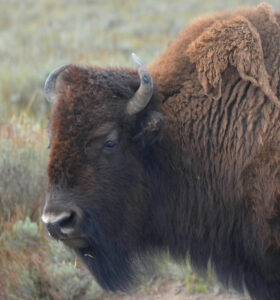
Yellowstone is home to roughly 5,400 bison, the largest bison population on public land in the United States and the only herd with an unbroken wild lineage dating back to prehistoric times. Bulls can weigh up to 2,000 pounds, making bison the largest land mammal in North America. Ecologists call them ecosystem engineers because their grazing keeps any single grass species from taking over, and the wallows they dig collect rain and snowmelt, creating small wet habitats that amphibians, insects, and ground-nesting birds depend on. Bison are one of five species covered in our full guide to Yellowstone’s Big 5 animals, alongside wolves, bears, elk, and moose.
How Bison Shape the Landscape
A single bison wallow looks like a shallow dust bowl until the rain comes. Then it becomes a pond that outlasts the surrounding grassland by weeks, giving frogs, dragonflies, and migrating shorebirds a foothold in an otherwise dry landscape. Multiply that by thousands of wallows across two herds and the effect on Yellowstone’s plant and insect diversity is measurable, not anecdotal. Their grazing does the same work in reverse, opening space for wildflowers and grasses that a uniform stand would crowd out.
Bear Facts: Grizzlies in the Fall
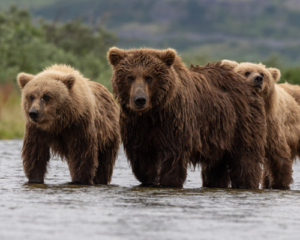
An estimated 1,030 grizzly bears live across the Greater Yellowstone Ecosystem, based on the most recent count. Every fall, they enter hyperphagia, a period of intense feeding that can push daily calorie intake past 20,000 as bears build fat reserves for winter denning. Grizzlies spend hyperphagia moving between whitebark pine stands at higher elevations, fruit bearing shrubs in the valleys, and any carcass they can find or claim from a wolf kill. That constant movement across a wide range is exactly why fall is one of the most productive seasons for bear sightings. Our post on why October is the best time to visit Yellowstone for wildlife covers hyperphagia in more depth, along with what it means for your own itinerary timing.
Elk Facts: The Rut and What It Means
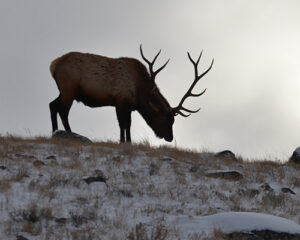
Elk are the most abundant large mammal in Yellowstone, with a population estimated between 10,000 and 20,000 across six to seven herds. Each September, bull elk enter the rut, gathering harems of cows, sparring with rival bulls, and bugling, a call that starts as a low moan and rises into a piercing whistle audible for miles. A bull in full rut can lose a meaningful share of his body weight over just a few weeks, since fighting and herding leave little time to eat. By the time the rut winds down in October, that exhaustion is visible, and bulls spend more time recovering in open ground where they are easiest to see. Our guide to Yellowstone’s Big 5 animals breaks down where each species is most reliably spotted.
Moose Facts: Yellowstone’s Quiet Giants
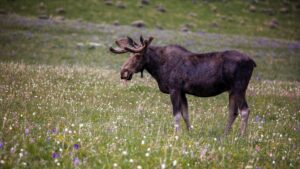
Moose are the largest members of the deer family, and Yellowstone’s bulls can weigh up to 1,200 pounds and stand six feet at the shoulder. Unlike bison and elk, moose are solitary and rarely form herds, which makes them the least predictable of the park’s large mammals to find on any given day. They favor willow flats, sedge meadows, and the marshy edges of rivers and lakes, where they wade in to feed on aquatic plants that most other Yellowstone herbivores cannot reach. If you want to see one, a women’s wildlife expedition in Yellowstone National Park built around field biology timing knows which valleys to check first.
Why October Is When You See It All
Every fact above points toward the same month. Wolf pups are old enough to hunt with the pack. Grizzlies are at peak hyperphagia and covering more ground than at any other time of year. Bison and elk move in large, visible groups across Hayden and Lamar Valley as the rut winds down. Moose are more active in daylight as their own rut ends. And summer’s crowds have thinned enough that you can actually watch behavior unfold instead of watching traffic. That convergence is not a coincidence. It is the reason Her Wild Life times its Yellowstone departure for October, and our full breakdown of the case for an October Yellowstone trip walks through each piece in more detail.
Yellowstone’s animals do not perform on a fixed schedule, but October is as close to a guarantee as field biology gets. To see the wolves, bears, bison, elk, and moose covered here in the same week, explore the full range of wildlife travel in the United States that Her Wild Life guides, or go straight to the Yellowstone departure details.