
The Yellowstone Big 5 are wolves, grizzly bears, bison, elk, and moose. These are the five species that define what Yellowstone’s ecosystem actually is. Her Wild Life is a women’s adventure travel company that builds its expeditions around field biology. Its Yellowstone Big 5 wildlife expedition for women runs in October because that is when all five are simultaneously active, visible, and doing the most interesting things they do all year.
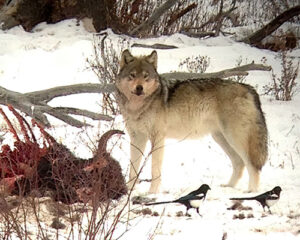
Wolves in Yellowstone National Park
Gray wolves were reintroduced to Yellowstone in 1995 after a 70-year absence. It is reported that around 84 wolves currently live in the park across multiple packs, with an average pack size of 11.8 individuals. In October, pups born the previous April are six months old and making their first serious attempts to hunt with the pack. That produces some of the most watchable wolf behaviour of the year as they test elk herds and pursue prey in tactics that are still developing. Lamar Valley is the most reliable location for sightings. For the full biology, see our post on wolf facts in Yellowstone.
Grizzly Bears in Yellowstone
Grizzly bears enter hyperphagia in fall, the intensive pre-hibernation feeding period, when they can consume up to 20,000 calories a day. In October, they cover more ground than at any other time of year, moving between whitebark pine stands at elevation, fruit-bearing shrubs in the valleys, and carcasses wherever they find them. Adult male grizzlies regularly displace wolf packs from kills at this time of year. That combination of high movement and high caloric drive makes October one of the most productive months for grizzly sightings in the park.

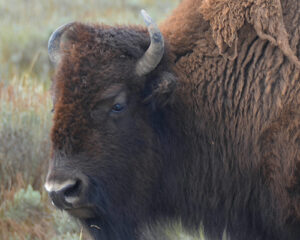
Bison in Yellowstone
Yellowstone supports between 4,500 and 5,500 bison across two main herds. Adult bulls weigh up to 2,000 pounds, making them the largest land mammals in North America. Their ecological role goes far beyond their size. Bison grazing patterns prevent any single plant species from dominating the grassland, creating habitat diversity that benefits dozens of other species. Their wallows collect water and create microhabitats for insects, amphibians, and ground-nesting birds. In October, the rut is over, and bison are moving in large groups across Hayden Valley and Lamar, conspicuous and photogenic in the low autumn light.
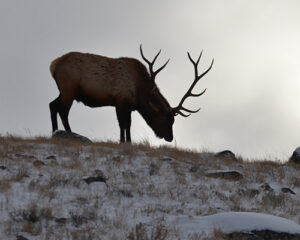
Elk in Yellowstone
Yellowstone’s elk population numbers between 10,000 and 20,000 individuals across six to seven herds. The rut peaks in September. By October, bull elk are exhausted after weeks of herding cows, bugling, and sparring with rivals. A bull in full rut can lose up to 20 percent of its body weight over the course of the season. In October, he is recovering and moving toward lower elevations where viewing is easiest. Bugling carries into mid-October in good years. Mammoth Hot Springs is one of the most reliable locations for close elk observation, where herds move onto the lawns and slopes of the village, and bulls are sometimes audible from the road before dawn.
Moose in Yellowstone
Moose are the largest members of the deer family and the least predictable of the Yellowstone Big 5 in terms of daily location. Adult bulls stand up to six feet at the shoulder and can weigh up to 1,200 pounds. They favour willow flats, sedge meadows, and aquatic vegetation along lake and river margins. The Madison River corridor, Willow Park near Norris, and the marshy edges of Yellowstone Lake are all productive areas. In October, bulls are coming out of the rut and tend to be more active and visible during daylight hours than in summer.
Why October Is the Best Month to See All Five
October is the one month when all five species are in a state of heightened biological activity at the same time. Wolves hunting with new pups. Grizzlies in their final intensive push before denning. Bison and elk move in large groups across open valleys. Moose are active at lower elevations as the rut ends. And the summer crowds are gone, which means Lamar Valley and Hayden Valley are quiet enough to watch behaviour unfold properly. For the full ecological case for October, see our post on why October is the best time to visit Yellowstone for wildlife. For how wolves changed rivers, vegetation, and prey behaviour across the entire park, see our post on the trophic cascade in Yellowstone.
For the full range of women’s wildlife expeditions across the US, see all wildlife expeditions in the United States.