
Yellowstone is home to one of the most closely studied wolf populations on Earth. Since their reintroduction in 1995, the park’s wolves have been tracked, analysed, and observed in ways that have changed how ecologists understand predator-prey dynamics across entire ecosystems. If you are planning a women’s wolf watching expedition in Yellowstone, here are the wolf facts that will change what you see when you get there. Her Wild Life is a women’s adventure travel company that puts you in the northern range, where the NPS describes wolf watching conditions as among the best in the world.
When Were Wolves Reintroduced to Yellowstone?
Wolves were extirpated from Yellowstone by the 1920s through a combination of hunting and government extermination programmes. In 1973, the U.S. Fish and Wildlife Service listed the northern Rocky Mountain wolf as an endangered species. Between 1995 and 1997, 41 wild wolves from Canada and northwest Montana were released in Yellowstone in three separate operations. January 2025 marked the 30th anniversary of their return. The ecological changes that followed have been studied continuously ever since, making the Yellowstone wolf population one of the best documented in the world.
How Many Wolves Are in Yellowstone?
Wolf numbers in Yellowstone have fluctuated between 83 and 123 individuals since 2009, according to the National Park Service. The population is not static. Disease, territory disputes, and mortality outside the park’s boundaries all affect numbers from year to year. Canine distemper outbreaks in 2005, 2008, and 2009 each reduced pup survival significantly. Sarcoptic mange, caused by a burrowing mite, reached epidemic levels in the northern range in 2009. The leading cause of death inside the park is other wolves, primarily in territorial conflicts between packs.
Wolf Pack Structure and Behavior
Wolves are highly social and live in family packs. In Yellowstone, the average pack size is 11.8 individuals, though this varies considerably. Each pack has an alpha male and alpha female, typically the primary breeding pair, and subordinate members who contribute to pup care, cooperative hunting, and territory defence. Packs defend their territory through howling and scent-marking with urine.
Yellowstone wolves come in two colour variants in roughly equal proportions: black and gray. The black coat is the result of a mutation in a single gene, the K-locus, which is believed to have originated in domestic dogs and entered wolf genetics through hybridisation in northwest North America within the last 7,000 years, as early humans brought dogs across the Bering Land Bridge. Research has since found that this gene is involved in immune function as well as coat colour, with black wolves showing greater survival rates during distemper outbreaks. Gray wolves show higher reproductive success and greater aggression in territorial conflict. These trade-offs appear to maintain both coat colours in the population.
Wolves mate in February and give birth to an average of five pups in April after a 63-day gestation. Pups emerge from the den at 10 to 14 days old. By October, when Her Wild Life’s Yellowstone expedition runs, the pups are approximately six months old and are making their first serious attempts to hunt with the pack.
Where Are Wolves Most Commonly Seen in Yellowstone?
The northern range of Yellowstone, and Lamar Valley in particular, is the most reliable area for wolf sightings. The valley’s open terrain, resident elk herds, and accessible road corridor make it possible to observe wolves at a distance with spotting scopes. Wolf activity peaks at dawn and dusk. Animals are often visible at half a mile or more in the open ground of Lamar, which is why high-quality optics are essential. Her Wild Life includes spotting scopes on its Yellowstone expedition.
Wolves are unpredictable in their movements. A pack that was in Lamar at dawn may be 10 miles away by afternoon. What makes wolf watching in Yellowstone consistently productive is not any guarantee of proximity but the quality of the habitat and the number of animals. The northern range has been described by the NPS as one of the best places in the world to watch wolves, and that assessment is based on decades of observation data.
Women’s Wolf Watching – Why Small Groups See More
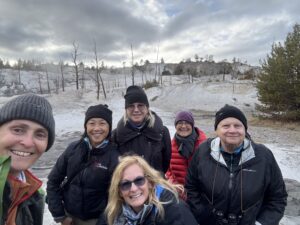
Small groups are quieter, more manoeuvrable, and easier to position quickly when a sighting develops. Her Wild Life’s Yellowstone expedition runs with 4 to 6 women in a custom safari van, guided by Carly Crow, whose ecology and biology background means every sighting comes with context. What the wolves are doing, what it predicts, and what the behaviour tells you about the health of the pack. For more on how wolves have transformed the entire Yellowstone ecosystem, see our post on the trophic cascade in Yellowstone. For the full range of women’s wildlife expeditions across the US, see all wildlife expeditions in the United States.
Her Wild Life’s 2026 Yellowstone departure runs from October 18 to 23. Spaces are limited to 4 to 6 women. See the Yellowstone Expedition.