
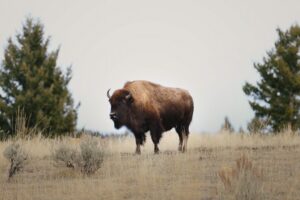
Bison are the animal most people expect to see in Yellowstone and the one whose actual impact on the landscape most visitors never hear about. Beyond the size and the horns, bison reshape the ground they walk on, and Yellowstone’s herd is the reason wild American bison exist at all. These bison facts cover the numbers, the ecology, the behavior, and the history behind a species that was down to two dozen animals in this park just over a century ago.
How Many Bison Are in Yellowstone?
The National Park Service’s 2025 pre-calving estimate puts Yellowstone’s bison population at nearly 5,300, within a historical range of 3,000 to 6,000 over recent decades. That population splits into two primary breeding herds. The northern herd breeds in Lamar Valley and the plateaus around it, while the central herd breeds in Hayden Valley. Yellowstone holds the largest bison population on public land in the country, and it is the only place in the lower 48 states where bison have lived continuously, without ever being fenced or removed, since prehistoric times.
How Do Bison Shape the Ecosystem?
Most grazing animals chase the season’s freshest growth, moving as new plants sprout across the landscape. Bison do something closer to the opposite. They let that green wave of new growth pass them by, then return to graze the same patches of ground repeatedly and intensively. That repeated grazing keeps the plants short but constantly regrowing and more nutritious than if they had been left alone, which is the mechanism behind calling bison ecosystem engineers rather than simply large herbivores. Over a year, Yellowstone’s bison travel roughly 1,000 miles between summer and winter range, farther than any other ungulate in the ecosystem, migrating up to 70 miles at a stretch as snowpack builds. Wolves are the other species that reshapes this landscape from the ground up. Our post on the trophic cascade in Yellowstone covers how predator behavior, not just prey numbers, changed entire river systems.
Bison Behavior: What to Expect in the Field
Bison group size shifts dramatically with the seasons. Expect groups of around 20 animals in winter, growing to roughly 200 in summer, and occasionally as large as 1,000 during the rut in late July and August. During the rut, bulls bellow, wallow in dust to display strength, and spar with rivals for access to females, then spend most of the rest of the year alone or in small bachelor groups. Calves arrive reddish tan in late April and May and can keep pace with the herd within hours of birth. Despite their bulk, bison can run up to 35 miles an hour and clear a five foot obstacle without slowing down, which is worth remembering at any viewing distance. For where bison fit among Yellowstone’s other large mammals, see our guide to Yellowstone’s Big 5 animals.
The Near Extinction and Recovery of American Bison
Between 30 and 60 million bison once ranged across North America. By 1872, market hunting and a deliberate U.S. Army campaign had reduced Yellowstone’s herd to around 1,000 animals, and by 1902 poaching had cut that number to roughly two dozen. The Army, which administered the park at the time, protected the survivors, and in 1902 the government brought 21 bison from private herds to Mammoth and, later, to the Buffalo Ranch in Lamar Valley to rebuild the population. Wild and captive bison gradually mixed over the following decades, and the ranching operation was phased out by 1952. Every bison in Yellowstone today descends from that recovery. It is one of the earliest and most complete conservation turnarounds in American wildlife history, and it happened in the same valleys where bison still breed today.
Bison do not need a single dramatic sighting to make an impression. A herd grazing Hayden Valley in the same rotation its ancestors used a century ago, on ground that survived near-extinction to get there, tends to do so on its own. See the Yellowstone wildlife expedition for women for departure dates.