

Where do monarch butterflies go in winter? Millions of them fly as far as 3,000 miles from the northern United States and southern Canada to a small cluster of mountain forests in central Mexico, arriving by early November and staying until March. It is one of the longest insect migrations on Earth, and no single butterfly completes the round trip. Here is where they go, how they find it, and why the forests waiting for them are more fragile than they look.
The Oyamel Fir Forests of Central Mexico
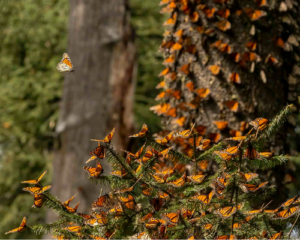
The monarchs’ destination is a narrow band of oyamel fir forest in the mountains of Michoacán and the State of Mexico, protected as the Monarch Butterfly Biosphere Reserve. Oyamel firs grow at around 3,000 meters, nearly two miles above sea level, on steep, southwest-facing slopes. At that altitude, the forest canopy works like a blanket and an umbrella at once. It holds in enough warmth to keep the butterflies just above freezing, and it breaks up the wind, rain, and snow that would otherwise kill them outright. Inside the reserve, monarchs cluster by the thousands on a single tree trunk, so densely that branches visibly bend under their weight. Researchers estimate colony size not by counting individual butterflies, which is not possible at this scale, but by measuring the area of forest the colonies occupy.
How Do Monarchs Know Where to Go?
The monarchs that arrive in Mexico each November have never made the trip before. Whichever butterflies left Mexico the previous spring are four or five generations removed from the ones returning this fall, since each generation along the way lives only a few weeks. What guides them is not memory but a built-in compass. Research out of the University of Massachusetts Medical School found that monarchs read the sun’s position using a circadian clock, and unlike almost every other animal studied, that clock sits in their antennae rather than their brain. Painting a monarch’s antennae black is enough to make it lose its sense of direction entirely, even though the clock in its brain keeps working normally. The exact handoff between antenna and route, generation after generation, is still being studied.
Why the Migration Is Under Threat
The eastern monarch population is measured each winter by the amount of oyamel forest its colonies cover, and the trend over three decades is stark. In the 1996 to 1997 season, monarchs occupied nearly 45 acres of forest. By the 2013 to 2014 season, that had fallen to under 2 acres. The 2025 to 2026 count showed a genuine bright spot, 7.24 acres, a 64 percent increase on the previous winter, but scientists still consider 15 acres the minimum needed for the population to be secure long term, a level reached only once in the last ten years. The pressures driving the decline have not gone away. Illegal logging inside the reserve has been reduced significantly through community-led conservation work, but it has not stopped. Milkweed, the only plant monarch caterpillars eat, continues to disappear from farmland across the United States and Canada as herbicide-resistant crops expand. The International Union for Conservation of Nature listed the monarch as endangered in 2022. For a closer look at how this year’s recovery is shaping the season ahead, see our post on one of the best monarch butterfly seasons in years.
When Is the Best Time to See the Overwintering Colonies?
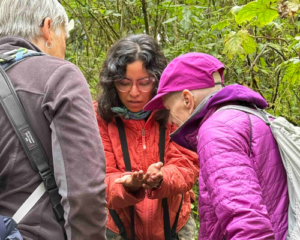
Monarchs begin arriving at the Mexican colonies in early November and stay until March, but the window for visitors is narrower than that. By December, the population has consolidated into its winter clusters, and colonies stay relatively stable through January and into February, before dry season conditions push butterflies out in search of water ahead of the spring migration. That stretch from mid-December through February is when the largest, most concentrated clusters are reliably found on the same trees year after year. Her Wild Life’s monarch butterfly expedition in Mexico is timed to this window, when the forest is at its fullest, and the colonies are least likely to have already started breaking apart.
Standing under a tree with thousands of monarchs settled into its branches is not a spectacle that needs narration. The scale does the work on its own. For departure dates and the full itinerary, see the women’s wildlife expeditions in Mexico that Her Wild Life runs each winter, timed to the exact weeks the colonies are at their most complete.