
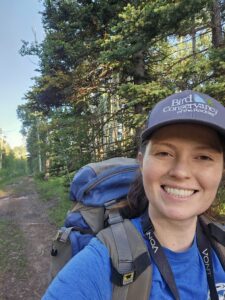
The first thing Carly Crow remembers is the cold. She was thirteen, far from home in southern Georgia, sleeping in a tent under a Wyoming sky as part of a Girl Scouts trip called Wyoming Wildlife Wonders, a journey through Grand Teton and Yellowstone. Then one evening she stepped outside her tent and looked up, and the stars stopped her. She had never seen a sky like that, and in that moment Yellowstone introduced her to wonder, the same wonder behind every Yellowstone conservation story that follows.
Earlier on that same trip, Carly and the other girls met a research ecologist studying mountain lions, capturing and collaring them to understand their movements and territory. Watching that woman work, Carly remembers thinking she absolutely had to become her. She does not recall the ecologist’s name, only the impression she left behind, and that impression became the start of Carly’s own path into biology, ecology, and conservation. Today Carly is one of Her Wild Life’s naturalist guides, leading travelers through wild places and sharing the same sense of discovery that first set her on this path.
Where the National Park Idea Began
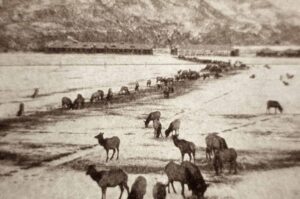
Carly’s story is not unique. For more than 150 years, people have arrived in Yellowstone and left seeing the natural world differently. This is where Yellowstone National Park history actually begins. On March 1, 1872, President Ulysses S. Grant signed the Yellowstone National Park Protection Act into law, making Yellowstone the world’s first national park. No government had ever set aside a landscape this large specifically to preserve it for future generations. Yellowstone was known then for its geysers and hot springs, but that protection also preserved one of the greatest wildlife strongholds on the continent, and the idea it started spread to more than 100 countries, each one built on the same belief, that some places are too important to lose.
The Return of the Wolf
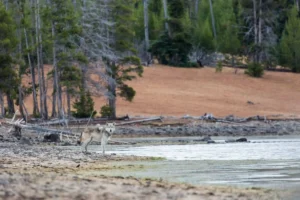
Wolves were eliminated from most of the lower 48 states by the early twentieth century, driven out through habitat loss and organized eradication. After the gray wolf was listed as endangered in 1973, its recovery in the northern Rocky Mountains became one of the most significant restoration efforts in American history. The wolf reintroduction Yellowstone carried out between 1995 and 1997 brought 41 wolves from Canada and northwest Montana back to the park. Three decades later, the park remains one of the best places in the world to study how the return of a single species can reshape an entire ecosystem, from elk behavior to riverbank vegetation.
A Bird, a Tree, and a Guide’s Own Beginning
The Yellowstone conservation story is not only about wolves and bears. Few examples define whitebark pine Yellowstone ecology as clearly as the partnership between Clark’s nutcrackers and these trees, a relationship that has held for thousands of years. Each autumn the birds collect the tree’s seeds and bury them across the landscape, and the seeds they never recover become the next generation of whitebark pine, a keystone species that grizzly bears, red squirrels, and dozens of other species depend on.
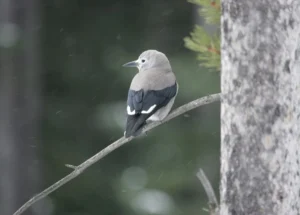
Ecologist Diana Tomback has studied this partnership for decades, and among the graduate students she mentored was Sheridan Samano, whose own research focused on Clark’s nutcrackers before she went on to found the company behind Her Wild Life. Tomback continues that work today through the Whitebark Pine Ecosystem Foundation, one of Her Wild Life’s named conservation partners. A portion of proceeds from Her Wild Life’s Yellowstone expedition supports the foundation’s work directly, so the line between a founder’s graduate research and a guest’s conservation donation runs closer and more directly than most travelers would ever guess.

What This Means for Her Wild Life’s Yellowstone Expedition
Her Wild Life’s Yellowstone expedition is timed for October, when the elk rut is winding down, bears are in hyperphagia, and wolf sightings are at their best odds of the year. The same conservation thread running through this article, a founder’s own research, a named partner still doing the work, and guides trained to read what the landscape is telling them, runs through every departure.
As America marks its 250th anniversary, Yellowstone offers a reminder of one of the country’s most meaningful contributions to the world, the idea that protecting nature is an investment in our shared future.
More than 150 years after Yellowstone became the world’s first national park, its greatest gift may still be the one Carly discovered as a teenager, the ability of a wild place to change the course of a life.
Ready to see Yellowstone for yourself? Explore our Yellowstone wildlife tours for women, or meet Carly Crow, one of the naturalist guides whose own path back to wild places started right here.