
October is the month field biologists consistently point to for serious wildlife watching in Yellowstone. The summer crowds are gone, the park’s animals are at their most behaviourally active, and the open valleys of Lamar and Hayden give you sightlines that simply do not exist in any other season. Her Wild Life is a women’s adventure travel company built around exactly this kind of field biology timing. Its October wildlife expedition in Yellowstone puts a group of 4 to 6 women in the park during the convergence of three distinct biological events: the tail end of the elk rut, peak bear hyperphagia, and wolf pups old enough to hunt with the pack for the first time.
The Elk Rut in October
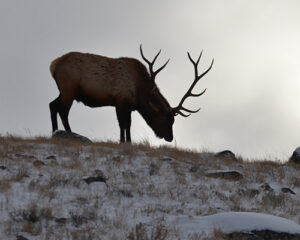
The elk rut peaks in September and extends into October. Yellowstone supports an estimated 10,000 to 20,000 elk across six to seven herds, and in October, the bull elk, which can weigh up to 1,000 pounds, are still herding cows, bugling across valleys, and in some cases sparring with rivals. Bugling has been recorded in Yellowstone as late as mid-October. It starts as a low resonant moan and rises into a high-pitched call that carries across open ground for miles.
Mammoth Hot Springs is one of the most reliable locations to observe the rut at close range. Bull elk gather with their harems on the lawns and slopes of the village in October, often visible and audible from the road. The Madison River corridor and Hayden Valley are also productive. By October the intensity of the rut is winding down, which means bulls are exhausted and tend to be more visible as they recover and begin feeding again before winter.
What October Means for Elk Sightings
As the rut concludes, elk herds begin moving toward lower elevations ahead of winter. That transition pushes animals into the valleys and along river corridors where viewing is easiest. October light is also considerably better for wildlife watching and photography than summer: lower angle, warmer tone, and shorter days that concentrate animal movement around dawn and dusk.
Bears in Hyperphagia – What That Means for Sightings
Hyperphagia is the period of intense pre-hibernation feeding that grizzly and black bears enter each fall. Research confirms the hyperphagia period runs from July through October, with the final weeks before denning representing the most sustained feeding activity of the year. Bears in hyperphagia are moving across larger areas than at any other time, which makes October one of the best months for sightings.
In October, Yellowstone’s bears are focused on maximising calories wherever the landscape offers them. At higher elevations, whitebark pine cones are releasing their fatty nuts, a critical food source that the Whitebark Pine Ecosystem Foundation, the conservation partner for Her Wild Life’s Yellowstone expedition, works specifically to protect. In the valleys, bears strip hawthorn, serviceberry, and chokecherry of their remaining fruits and seek out protein from carcasses. Larger male grizzlies are known to displace wolf packs from kills at this time of year. Watch treelines and south-facing slopes in the early morning.

Wolf Activity in October
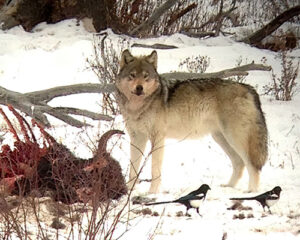
Yellowstone’s gray wolves were reintroduced in 1995, and the park has been studying the ecological effects ever since. By October, the wolf pups born the previous April are approximately six months old and making their first serious attempts to hunt with the pack. They are nearly adult-sized but still learning, which produces some of the most watchable wolf behaviour of the year as they test bison herds and pursue elk.
As elk movement shifts toward lower elevations ahead of winter, wolf packs follow. Lamar Valley is the most reliable location for wolf sightings in the northern range and is the primary focus of Her Wild Life’s Yellowstone expedition. High-quality spotting scopes are included on the trip. For more on how the return of wolves has transformed the entire Yellowstone ecosystem, down to the course of its rivers, see our post on the trophic cascade in Yellowstone.
Fewer Crowds, More Wildlife
Yellowstone receives the majority of its annual visitors in June, July, and August. By mid-October, the park is operating at a fraction of summer capacity. Fewer vehicles means less road noise, less disturbance to animals near the road, and significantly better conditions for spotting wildlife that would otherwise be pushed back from view. Her Wild Life offers women’s wildlife trips across the United States and beyond, all timed around the same field biology logic: when is each species most active, most visible, and most worth being there for. October in Yellowstone is one of the clearest answers to that question.
Her Wild Life’s Yellowstone departure is October 18 to 23, 2026, deliberately timed to land after the bulk of fall visitor traffic while the key biological events are still active. The group travels in the Roaming Bison, Her Wild Life’s custom safari van, which means warm, comfortable travel between locations with the ability to exit immediately whenever an animal is spotted.
Your Guide – Carly Crow
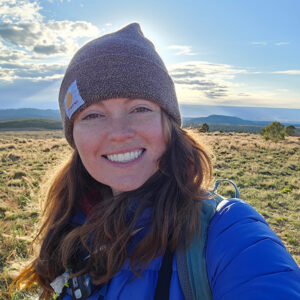
The expedition is led by Carly Crow, a naturalist with a Bachelor of Science in ecology and a master’s in biology with a focus on ecology and evolution. Her background as a field ornithologist means the expedition covers far more than the Big 5 of bears, bison, elk, moose, and wolves. Corvids, raptors, and waterfowl are active throughout October, and Carly’s field experience means nothing moves within the landscape without context. She knows what the behaviour means, what it predicts, and where to position you next.
What October Conditions Feel Like in the Field
Temperatures range from below freezing before dawn to mild afternoons. Early starts are non-negotiable for the best wildlife. Hiking of up to 2 to 3 hours a day across uneven terrain, with the possibility of rain or snow depending on conditions. The park’s geothermal features are also more dramatic in October than in summer, with steam rising from hot springs and geyser basins in the cold morning air in a way that creates a completely different visual experience of the landscape.
For the full picture on women’s wildlife expedition opportunities across the US, including Yellowstone, Kodiak, and Nebraska, see all wildlife adventures in the United States.
The 2026 departure runs from October 18 to 23. Groups are 4 to 6 women, and spaces are limited. See the Yellowstone Expedition.