

Packing for Yellowstone in October is different from packing for a summer park visit. October means pre-dawn temperatures below freezing, variable weather that can shift from sun to snow within hours, and long hours in the field starting at first light. Her Wild Life is a women’s adventure travel company that builds its expeditions around field biology timing. On its Yellowstone wildlife expedition for women, the group is in the park from 7 am across terrain that ranges from valley roads to uneven trails. What you pack determines how present you can be for what you are actually there to see.
Layering for Cold Yellowstone Mornings
The layering system is the most important packing decision you will make. October in Yellowstone means temperatures can be below freezing at dawn and mild by midday. You need to be able to add and remove layers without losing time in the field. Wool and synthetic fabrics are the right choice throughout. Cotton loses its insulating value when wet and dries slowly, which makes it a poor choice for a day that may involve damp, cold, rain, or light snow.
The Core Layering System for October Yellowstone
- Base layer top and bottom: merino wool or synthetic moisture-wicking fabric. This goes against your skin and keeps you dry as you warm up walking.
- Mid-layer: a packable down or synthetic insulating jacket that compresses small enough to go in your daypack when you no longer need it.
- Outer shell: a lightweight, waterproof and windproof jacket large enough to fit over all your other layers. Rain and snow are both possible in October.
- Warm hat and gloves: non-negotiable for pre-dawn starts. Ear warmth matters more than most people expect when you are standing still watching wildlife.
- Neck gaiter or buff: keeps warmth in when the wind picks up in the valley.
- 2 to 3 pairs of wool or synthetic hiking socks: feet that get cold early limit how long you stay out.
For hiking, synthetic pants that dry quickly work better than denim or cotton. Waterproof hiking boots, broken in before the trip, are essential. The expedition involves hiking up to 2 to 3 hours a day across terrain that can be icy, depending on recent weather.
Essential Wildlife Watching Gear
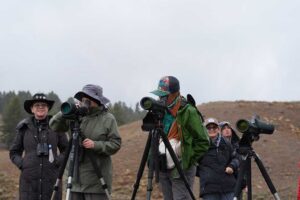
Gear for a wildlife expedition is different from gear for a general park visit. You are not at a viewpoint for ten minutes. You are in the field for hours, watching animals at a distance, in variable light and cold.
Optics
Binoculars are the single most important piece of equipment for a Yellowstone wildlife expedition. In Lamar Valley, where wolf sightings are most consistent, animals are often visible at half a mile or more. Without binoculars, a wolf pack in open ground is a series of small shapes. With a good pair, you are reading individual behaviour. An 8×42 or 10×42 is the right range for October in Yellowstone: enough magnification to resolve detail at distance, light enough to hold steady through long periods of scanning. Her Wild Life is a ZEISS Optics official partner. High-quality spotting scopes are included on the expedition, so you do not need to bring your own. For more on choosing the right optics, see our post on binoculars for wildlife watching.
Camera
Bring whatever camera you are confident using. A smartphone with a good zoom works for record shots. If you are shooting wildlife seriously, a telephoto lens of 300mm or longer gives you enough reach for animals at a distance in Lamar Valley. October light in Yellowstone is excellent: lower angle, warmer tone, and golden hours that last longer than in summer. The cold also means atmospheric steam from geothermal features at dawn, which creates conditions that simply do not exist in any other season.
Other Field Essentials
- Daypack large enough to carry all your layers plus water, snacks, and camera gear.
- Water bottle or hydration system: staying hydrated at altitude in cold weather is easy to neglect.
- High-calorie field snacks: granola bars, nuts, dried fruit. Brunch is included on the Her Wild Life expedition, but you will want something in your pocket for early morning.
- Bear spray: required in Yellowstone backcountry and strongly recommended for any time you are on foot away from the vehicle. Rentals are available in gateway communities if you cannot travel with it.
- Sunscreen and lip balm: the sun at Yellowstone’s elevation is intense even in October and reflects off any snow on the ground.
- Notebook or journal: Carly Crow’s field explanations of animal behaviour are worth writing down.
What Not to Bring
Cotton in any form, including jeans and cotton hoodies. It provides no warmth when wet and takes too long to dry for a day that may shift from cold and damp to mild and back again.
Heavily fragranced products, including perfume, scented sunscreen, and strongly scented hair products. Wolves and bears have a highly developed sense of smell. There is no need to announce your presence before you leave the vehicle.
Unnecessary luggage. The group travels in a custom safari van and stays at one property, Yellowstone Big Rock Inn, for the full expedition. A single bag that holds your layers and gear is all you need. Packing light keeps you mobile.
A Note on Colours and Wildlife Viewing
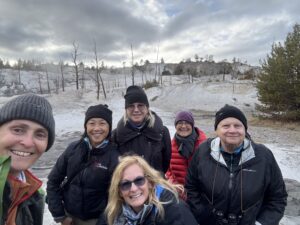
Muted, earth-toned clothing performs better in the field than bright colours. This is not about concealment in any hunting sense. It is about not drawing unnecessary attention when you are close to animals. Wolves in particular are known to notice and respond to unusual visual stimuli at a distance. Olive, brown, grey, tan, and dark green are all fine. Avoid white, bright orange, and neon in any shade.
For a broader packing guide covering Her Wild Life expeditions across different destinations and seasons, see our post on what to pack for a wildlife expedition as a woman.
Her Wild Life’s October departure runs from October 18 to 23, 2026. Groups are 4 to 6 women. See the Yellowstone Expedition.