

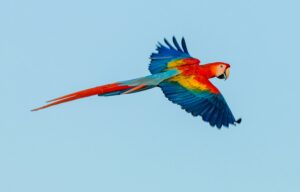
Scarlet macaws are among the most recognizable birds on Earth, and one of the tropical birds Costa Rica is most closely associated with. The Osa Peninsula is one of the last strongholds where a wild, self-sustaining population has never disappeared. Here are the scarlet macaw facts behind that status, including their diet, how they breed, and when to actually see them.
What Is a Scarlet Macaw?
|
Trait |
Detail |
|
Scientific name |
Ara macao |
|
Subspecies in Costa Rica |
Ara macao cyanoptera |
|
Length |
Around 32 inches, including the tail |
|
Weight |
Around 2.2 pounds |
|
Lifespan |
Documented to live 70 to 80 years |
|
Plumage |
Bright red body with yellow and blue wing feathers, long red tail feathers |
|
Diet |
Fruits, large hard seeds and nuts, and occasionally riverbank clay |
Scarlet macaws belong to the parrot family, and their large, powerful beak is built to crack open the hard seed casings that make up much of their diet, including the seeds of the Dipteryx panamensis tree, an important food source across parts of their Central American range, and the beach almond tree, whose oily seeds have helped support macaw populations along Costa Rica’s Pacific coast specifically. One detail that surprises most first-time visitors is the clay-eating: macaws will visit riverbanks and exposed clay banks specifically to eat the clay itself, which is understood to help neutralize the natural toxins found in some of the unripe seeds they eat elsewhere in their diet.
Where Do Scarlet Macaws Live in Costa Rica?
Scarlet macaws are found along Costa Rica’s Pacific coast, with Carara National Park and the Osa Peninsula, including Corcovado National Park, standing out as the two most reliable strongholds in the country. Their range extends from southern Mexico through Central America, but populations here are localized rather than continuous, concentrated in the areas where old-growth trees still provide the large nesting cavities they depend on.
Not every scarlet macaw population in Costa Rica tells the same story. In parts of Guanacaste and the Nicoya Peninsula, macaws had disappeared entirely and only exist today because of reintroduction and breeding programs, most notably the Macaw Recovery Network’s work at Punta Islita. The Osa Peninsula’s population is different. It is understood to be one of the strongholds where wild macaws were never lost in the first place, a reflection of how much primary rainforest still remains intact there.
Scarlet Macaw Breeding and Nesting
Scarlet macaws mate for life, and pairs typically nest in natural cavities within tall, mature trees, since younger secondary forest rarely has trees old enough to provide a cavity large enough for a nest. In Costa Rica, breeding season runs roughly from December through June. A female typically lays two to three eggs, and incubation, done mostly by the female, takes around 30 to 35 days. Chicks remain in the nest for an unusually long time for a bird their size, closer to 20 weeks before fledging, and it is common for only one chick per clutch to survive to that point. Both parents share the work of feeding the chick that does. Young macaws stay close to their parents well after fledging, and it takes three to four years before a young bird reaches breeding age itself.
Scarlet Macaw Behavior and Pair Bonds
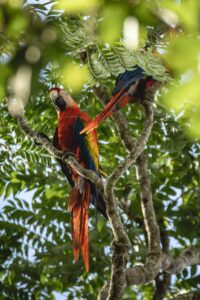
Sightings are almost always of a pair or a small family unit of three, a reflection of how tightly bonded a mated pair stays year-round, not just during breeding season. Their calls are loud and raucous, built to travel over a mile through dense forest canopy, which often means you hear a pair before you see them. One lesser-known fact: macaws show a preference for using one foot over the other to grasp food, a form of handedness similar to what humans display.
Best Time of Year to See Scarlet Macaws in Costa Rica
Nationally, the dry season from December through April is generally considered the best window for birding in Costa Rica, since clearer trails and thinner canopy make any bird easier to spot, and that window also overlaps with scarlet macaw breeding season. The Osa Peninsula does not follow that pattern as strictly. On Her Wild Life’s Costa Rica wildlife expedition for women, which runs in August during the wet season, scarlet macaws are visible year-round, typically easiest to spot in early morning moving through the canopy in pairs. If scarlet macaws specifically are the reason for your trip, timing matters less on the Osa than it does almost anywhere else in the country.
Scarlet Macaw Conservation in the Osa Peninsula
Scarlet macaw numbers across Costa Rica dropped sharply through the twentieth century, driven by deforestation and the illegal pet trade. Today the national wild population is estimated at more than 2,000 individuals, a genuine recovery built on decades of habitat protection and, in some regions, active reintroduction. The Macaw Recovery Network’s breeding and release program at Punta Islita is the best-known example, having restored a population to part of the Nicoya Peninsula where macaws had been locally extinct.
The Osa Peninsula’s contribution to that recovery is different in kind. Corcovado National Park protects the largest remaining stand of primary rainforest on the Pacific coast of the Americas, and it is that intact habitat, rather than a breeding program, that has kept scarlet macaws here without interruption. Entry to Corcovado requires a certified guide, which keeps daily visitor numbers and the disturbance to nesting macaws low. Her Wild life’s Costa Rica expedition operates in this same landscape, guided by resident biologist Arlet Quirós Calvo, whose field experience covers exactly this kind of species-specific knowledge, where the fruiting and nesting trees are, and when a pair is likely to be moving through.
Frequently Asked Questions
Where is the best place to see scarlet macaws in Costa Rica?
Carara National Park and the Osa Peninsula, including Corcovado National Park, are the two most reliable strongholds in the country.
How long does it take scarlet macaw eggs to hatch?
In Costa Rica, incubation takes around 30 to 35 days, and chicks remain in the nest for close to 20 weeks before fledging.
What do scarlet macaws eat?
Mostly fruit and large, hard seeds and nuts, including the beach almond and Dipteryx panamensis, along with occasional clay from riverbanks to help neutralize toxins in some of the seeds they eat.
Is the Osa Peninsula's scarlet macaw population a reintroduction success story?
No. Unlike parts of Guanacaste and Nicoya, where macaws disappeared and were later reintroduced, the Osa’s population is understood to be one of the strongholds where wild macaws were never lost.
Curious to see scarlet macaws for yourself? Explore the full picture of Osa Peninsula wildlife, when to go for the best wildlife encounters across the Osa more broadly, or the Costa Rica wildlife expedition for women built around this exact ecosystem, part of our wider rainforest wildlife travel in Central America.