

Are monarch butterflies endangered? By one measure, yes. The International Union for Conservation of Nature listed the monarch as Endangered in 2022. By another measure, the answer is more complicated. In the United States, the monarch still has no federal protection at all, even though a threatened species listing has been proposed for years. Here is what the monarch’s conservation status actually means, what is driving the decline, and what real conservation work looks like on the ground in Mexico.
What Is the Monarch Butterfly’s Conservation Status?
The IUCN Red List and the U.S. Endangered Species Act are two different systems, and monarchs currently sit in a different place on each one. The IUCN, which assesses global extinction risk, listed the monarch as Endangered in 2022, citing population declines of more than 80 percent in the eastern migratory population and steeper losses in the west. In the United States, the Fish and Wildlife Service proposed listing the monarch as threatened under the Endangered Species Act in December 2024, after a decade of petitions, lawsuits, and a 2020 finding that protection was warranted but delayed by higher priority species. That proposal has still not been finalized. Late in 2025, the federal government moved the rule into a long-term action category, pushing a final decision to at least fall 2026. As of this writing, monarch butterflies in the United States have no binding federal protection, regardless of their IUCN status.
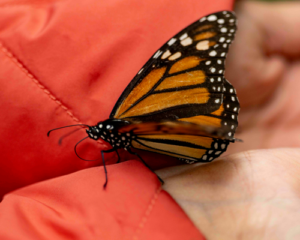
What Are the Main Threats to Monarch Butterflies?
Monarchs are being squeezed from both ends of their migration. In their U.S. and Canadian breeding range, milkweed, the only plant on which they lay eggs, has been disappearing for decades as herbicide-resistant crops and pesticide use expand across farmland. In their Mexican overwintering grounds, the oyamel fir forest that protects them from winter cold has been reduced by decades of logging, some of it illegal. Climate change compounds both problems, shifting the timing of milkweed availability in the north and increasing the frequency of severe storms and drought in the Mexican reserve. The numbers reflect it. The eastern population has declined by roughly 80 per cent since the 1990s. The western population, which overwinters along the California coast rather than in Mexico, has fared worse. In one recent winter count, it fell from 233,394 butterflies to just 9,119, a 96 percent drop in a single year. Federal biologists have estimated a 56 to 74 percent chance of extinction for eastern monarchs within 60 years, and a 99 percent chance for the western population.
What Conservation Is Being Done in Mexico?
Mexico’s response has been underway for over two decades. A presidential decree in 2000 expanded the Monarch Butterfly Biosphere Reserve to nearly 139,000 acres, and WWF has run a dedicated Monarch Program in the region since 2003. The most effective work has focused less on policing the forest and more on giving the people who live in it a reason not to log it. Thirteen community-run nurseries have produced more than 21 million oyamel and pine trees since the program began, and alternative income sources including mushroom farming and ecotourism have reduced how many households depend on logging to get by. According to Monarch Joint Venture, illegal logging inside the reserve’s core zone has been virtually eliminated as a result. The most recent count backs this up. Monarchs occupied 7.24 acres of forest in the 2025 to 2026 season, a 64 percent increase on the year before and one of the strongest single-year rebounds on record, detailed further in our post on one of the best monarch butterfly seasons in years. Scientists still consider roughly 15 acres the minimum for a genuinely secure population, a level reached only once in the last decade, so the recovery is real but partial.
Why Responsible Wildlife Tourism Matters for Monarchs
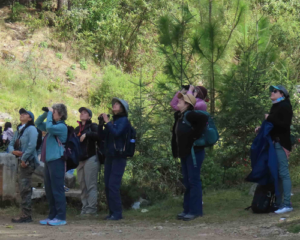
Ecotourism only helps monarchs if it is actually structured to help them, and that distinction is the whole point of how Her Wild Life runs its Mexico expedition. A conservation donation is made on behalf of every traveler to Alternare, a Mexican organization working directly with communities around the sanctuaries on sustainable agriculture, forest protection, and long-term stewardship, not a vague offset with no name attached. The economic argument matters as much as the ecological one. When a community earns more from guiding travelers to see the colonies than it would from logging the trees those colonies depend on, the forest gets protected as a side effect of people’s livelihoods, not just a rule enforced from outside. In the field, that means staying on marked trails, keeping distance from roosting trees, and following a guide who knows exactly how much foot traffic a given colony can handle in a season. None of it is difficult. All of it is the reason the forest is still there for the conservation focused monarch butterfly expedition to visit at all.
See the conservation wildlife travel in Mexico that Her Wild Life offers, or go straight to expedition dates and details.