

Every summer, hundreds of whale sharks gather in the waters off Isla Mujeres, Mexico, to feed on one of the largest plankton concentrations in the world. It is one of the most accessible large wildlife encounters on Earth and one of the most extraordinary. Here is everything you need to know about these animals and what to expect before you get in the water with them on a women’s wildlife expedition in Mexico.
What Are Whale Sharks?
Whale sharks are fish, not whales. The name comes from their size and their filter-feeding behavior, which resembles how baleen whales eat, not from any biological relationship. They are the largest fish species alive, with most adults measuring between 8 and 12 metres and weighing approximately 15 tons. The largest individual reliably recorded measured 18.8 metres. They are slow swimmers, moving at around 3 miles per hour, which is what makes swimming alongside them possible for snorkelers.
How Do Whale Sharks Feed?
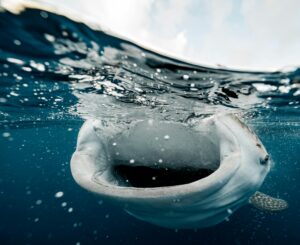
Whale sharks are filter feeders. They swim forward with their mouths open, drawing in enormous volumes of water and straining out plankton, fish eggs, krill, and small schooling fish through mesh-like pads in their gills. Their over 3,000 teeth play no role in feeding. Their throat is approximately the size of a quarter. For a breakdown of how they feed, see our post on what whale sharks eat.
How Long Do Whale Sharks Live?
Their estimated lifespan is 80 to 130 years, based on studies of vertebral growth bands. They grow slowly and do not reach sexual maturity until around 30 years old. Each individual carries a unique pattern of pale spots and stripes on dark grey skin. Researchers use photographic identification to track specific animals across seasons and locations, the same way fingerprints are used to identify people.
Why Do Whale Sharks Gather at Isla Mujeres?
The waters off the northeast Yucatan Peninsula experience a seasonal upwelling of cold, nutrient-rich water that triggers dense plankton blooms at the surface. Those blooms attract little tunny tuna to spawn in the area at night. Their eggs rise to the surface at dawn. Whale sharks arrive to feed. In 2009, a single aerial survey at the Afuera site, east of the tip of the peninsula, recorded 420 whale sharks feeding in one stretch of water – the largest aggregation ever documented.
When Is Peak Whale Shark Season at Isla Mujeres?
The season runs from May through September. Peak aggregation is June through August when plankton concentration and little tunny spawning overlap most intensively. Her Wild Life’s departure is timed for early August. The excursions travel 25 miles offshore to reach the Afuera feeding grounds, where the largest concentrations occur.
What to Expect When You Swim With Whale Sharks at Isla Mujeres
The boat leaves early. Whale sharks feed most actively at the surface in the morning when light and food concentration are both at their peak. When your guide spots an animal, she positions the group for entry. Two swimmers enter the water at a time alongside the guide. You do not chase the shark. You enter ahead of it and let it come to you, swimming alongside its mid-section, where the view is clearest, and you are away from the tail.
The animal does not register you the way you register it. It is focused entirely on food, moving slowly and steadily through the water. What most women describe afterward is not what they expected. They expected the size. What they were not prepared for was the stillness of it. An animal that large, that close, entirely absorbed in something else.
Her Wild Life runs two dedicated whale shark excursion days on its Isla Mujeres expedition. Each day on the water is different. Conditions vary, the sharks move, and no two outings are alike.
Do You Need Experience to Swim With Whale Sharks?
No scuba certification is required. The encounters are snorkelling, not diving. The water off Isla Mujeres in August is warm and clear. Women who have never snorkelled before join these trips regularly. Your guide manages positioning relative to the animal throughout.
Essential Gear for Swimming With Whale Sharks
Her Wild Life provides a full pre-swim briefing and manages all logistics on the water.
- Mask and snorkel: a well-fitting mask with a good seal is the single most important piece of equipment.
- Fins: lightweight and flexible. They let you keep pace with the shark without tiring.
- Life jacket or wetsuit: required on Her Wild Life excursions for buoyancy.
- Reef-safe sunscreen only: conventional sunscreen damages marine ecosystems. This is non-negotiable in the Yucatan’s protected waters.
Safety Tips and Etiquette for Swimming With Whale Sharks
Whale shark encounters are guided and regulated for good reason. These are wild animals in open ocean. Following the protocols protects both the sharks and the people in the water with them. Her Wild Life covers all of this in the pre-swim briefing, but here is what to know in advance:
- Keep your distance from the tail. The tail generates real force as the shark moves. Your guide positions the group alongside the animal’s mid-section. Stay there.
- Never touch the shark. Touching stresses the animal, disrupts its feeding, and can remove the protective mucus layer on its skin. It is also illegal under Mexican marine regulations.
- Stay horizontal in the water. Avoid diving down toward the shark or swimming above it. Horizontal keeps you visible to the guide and respectful of the animal’s space.
- Do not use flash photography. Flash can startle the animal and end the encounter for the whole group.
- Follow your guide’s signals immediately. She is reading the animal’s behavior in real time. When she signals to move, move.
- Be patient. Nature does not run on a schedule. Some encounters last seconds. Some last minutes. Some days the sharks are fewer. That is the wild, and it is part of what makes the experience genuine.
If you have questions about what whale sharks are actually like in the water before you go, our post on are whale sharks dangerous covers what their biology tells you about the encounter, or feel free to contact us; we would be happy to tell you more about what to expect on this wildlife expedition.
Swimming With Whale Sharks as a Women’s Wildlife Experience
Her Wild Life’s Isla Mujeres expedition is led by Naara Arroyo, a naturalist guide born in Mexico City and based in Playa del Carmen. Naara studied linguistics before following her connection to the natural world into guiding. She describes moments in the field, including standing among monarch butterflies, as spiritual. Her guiding style blends quiet observation with genuine physical confidence: she swims in cenotes, practices yoga, and trains in aerial dance. In the water with whale sharks, she reads animal behavior the way a field biologist reads a landscape, by what is moving, what has changed, and where to position you for the best encounter. The group on this expedition is 6 to 9 women. Private rooms are included at Playa La Media Luna, a beachfront hotel with direct access to Playa Norte. To see the full itinerary and departure dates, visit the Swimming with Whale Sharks expedition page.
Conservation: Why Responsible Whale Shark Tourism Matters
Whale sharks are listed as Endangered on the IUCN Red List, with populations declining due to targeted fishing for their meat, fins, and liver oil, bycatch in commercial fisheries, and vessel strikes. The Afuera site, where the largest aggregations occur, sits partly outside Mexico’s official protected zone for whale sharks, meaning this critical habitat has limited formal protection.
A conservation donation to the Marine Megafauna Foundation is included with every Her Wild Life booking on this expedition. MMF is an international nonprofit combining scientific research with community partnerships to protect whale sharks, manta rays, sea turtles, and dugongs globally. Their work in the Yucatan directly supports the fishing communities that are transitioning to conservation-based ecotourism. Traveling with an operator who takes that transition seriously is part of what this trip is about.
How to Choose a Responsible Whale Shark Operator
Not all whale shark tours are equal. When evaluating operators, look for:
- Small group sizes that reduce pressure on the animals and give each swimmer more time in the water.
- Guide-led entries with a maximum of two swimmers per shark at any time.
- No feeding or baiting of animals.
- Named conservation partnerships and transparent donation practices.
- Clear briefings on approach protocols and what happens if an animal shows avoidance behavior.
Her Wild Life meets all of these standards. The Isla Mujeres expedition is designed around the animals, not around producing the most dramatic footage possible.
Frequently Asked Questions About Swimming With Whale Sharks
Do I need to know how to dive to swim with whale sharks?
No. All Her Wild Life whale shark encounters are snorkelling, not scuba diving. No certification is required.
Is swimming with whale sharks suitable for beginners?
Yes. Many women on Her Wild Life expeditions are first-time snorkellers. Your guide manages all positioning relative to the animal. The water off Isla Mujeres in peak season is warm, calm, and clear.
How close do you get to whale sharks?
On a well-run expedition you will swim alongside the animal at a few metres distance, level with its mid-section. The encounters are intimate but guided. You are close enough to see the individual spot pattern on the skin.
How big are the whale sharks at Isla Mujeres?
The animals at the Yucatan aggregation are mostly juveniles and subadults, typically between 5 and 10 metres. Occasionally, larger adults are present. For full-size context, see our post on how big whale sharks get.
What is included in the Her Wild Life whale shark expedition?
Four nights’ accommodation at Playa La Media Luna with private rooms included, two private charter whale shark excursions, expert naturalist guide Naara Arroyo, plus a local host, meals as listed, airport transfers, and a conservation donation to the Marine Megafauna Foundation.