
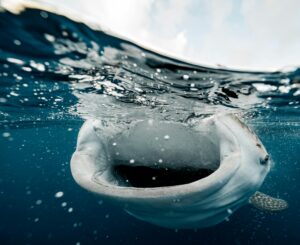
Whale sharks eat plankton, fish eggs, krill, crab larvae, and small schooling fish. They are filter feeders, which means they do not hunt or chase prey. They swim forward with their mouths open, draw in enormous volumes of water, and filter out whatever food is in it through mesh-like pads in their gills.
How Do Whale Sharks Feed?
A whale shark’s mouth can measure close to five feet across and contains over 300 rows of teeth. Those teeth play no role in feeding. Instead, the animal uses specialized filter pads in its pharynx that work like a fine mesh sieve, allowing water to pass through while retaining food particles as small as a few millimeters. A whale shark can filter thousands of liters of water in an hour this way.
When dense patches of food are near the surface, whale sharks have also been observed feeding vertically, hanging upright in the water column, and using a suction motion to draw food down into the mouth. Researchers have observed them coughing periodically to clear accumulated particles from their filter pads, the same way you would clear a clogged strainer.
Why Do Whale Sharks Gather Off the Yucatan Peninsula?
The waters off the northeast coast of the Yucatan Peninsula experience a tropical upwelling that pulls cold, nutrient-rich water toward the surface, triggering dense plankton blooms. Those blooms attract small fish, including little tunny tuna, which spawn in the area between May and September, releasing clouds of eggs that rise to the surface at dawn. Whale sharks follow the food. In 2009, a single aerial survey recorded 420 whale sharks feeding in one stretch of water off Isla Mujeres, the largest aggregation ever documented.
What This Means for When You Swim With Them
The timing of a Her Wild Life departure is built around when the food concentration is highest, which is when the sharks are most active at the surface and encounters in the water are most consistent. Her Wild Life guides know these patterns because they have spent time in these waters studying them. For the full picture on whale shark expedition in Mexico, including both the whale shark and monarch butterfly seasons, the Mexico page has the detail.
To see departure dates for the whale shark season, start here.
Reference
de la Parra Venegas et al. (2011), PLOS ONE. DOI: 10.1371/journal.pone.0018994